Showing posts with label Reading. Show all posts

Sunday, October 25, 2015

Text Structures


D: What are text structures?


Text structures are patterns authors use to organize information.


P: How do I find text structure?

  1. Read the text well. 
  2. Check your understanding.
  3. Tell the main idea.
  4. Ask yourself, "How is the information presented?"
  5. Look for signal words.


C: Why do we use text structures?


Knowing text structures helps us remember better, read it faster, and make better predictions.

Thursday, October 1, 2015

Main Idea


D: What is main idea?

  • Main idea is the big idea in a nonfiction text.

P: How do I find main idea?


  1. Read the text. 
  2. Check your understanding. Reread.
  3. Find the repeating idea.
  4. Find the idea that connects everything together.

C: When/why do I find main idea?


  • Good readers use main idea to learn from nonfiction texts.


Wednesday, September 30, 2015

Theme

D: What is theme?

  • Theme is the life lesson (moral) in a work of fiction.

P: How do I find theme?

  • Find the character who changed.
  • Ask, "How did the character change?"
  • Ask, "What does this tell me about life?"

C: When/why do I find theme?

  • I find theme during/after reading.
  • I find theme because it helps me apply the story to my own life.

Tuesday, September 29, 2015

Elements of Procedural Genre


D: What is the procedural genre?


  • Procedural texts are "how-to" text. They teach you how to do something.
  • Written with steps in sequential order
  • Nonfiction

P: How do I read a procedural text?


  • Read the whole text once to get the gist of the task/recipe/game/instructions.
  • Pay attention to the steps and focus on the order.

C: When/why do read procedural texts?


  • We read procedural texts to learn how to do something.


(13)  Reading/Comprehension of Informational Text/Procedural Texts. Students understand how to glean and use information in procedural texts and documents. Students are expected to:
(A)  interpret details from procedural text to complete a task, solve a problem, or perform procedures; and

Elements of Persuasive Genre

D: What is persuasive writing?


  • Persuasive writing is texts that try to convince you to buy something, do something, or believe something.

P: How do I read a persuasive text?


  • I look for the AAA!
  • I look out for exaggerations (bigger than reality).


C: Why do we read persuasive texts?

  • Decide who to vote for
  • Look for commercial deals
  • Challenge our beliefs


(A)  identify the author's viewpoint or position and explain the basic relationships among ideas (e.g., parallelism, comparison, causality) in the argument; and

(B)  recognize exaggerated, contradictory, or misleading statements in text.

Inferencing

D: What is an inference?


  • An inference is a conclusion (idea) you make by connecting what you read to what you know.

P: How do I make an inference?

  1. I can retell what I read accurately.
  2. I connect what I read to what I know.

Do this: 

Not this:


And definitely not:


C: When/Why do I make inferences?

  • I make inferences during/after reading.
  • I make inferences because it brings me to a deeper understanding of the text. 


Monday, September 28, 2015

Elements of Biography: PDAS

D: What is a biography?


A biography is the story of someone's life.

  • Nonfiction
  • Sequential text structure

P: How do we read biographies?


Look for P.D.A.S.!

People: Who are the important in his/her life?
Dates: When did this person live?
Accomplishments: What is he/she famous for?
Struggles: What problem did he/she have?

C: When/why do we read biographies?


  • We read biographies to inform ourselves about other people and how they helped make the world a better place.
  • We read biographies because we want to be inspired. 

(7)  Reading/Comprehension of Literary Text/Literary Nonfiction. Students understand, make inferences and draw conclusions about the varied structural patterns and features of literary nonfiction and provide evidence from text to support their understanding. Students are expected to identify the literary language and devices used in biographies and autobiographies, including how authors present major events in a person's life.

Sunday, August 30, 2015

Independent vs. Interactive Reading Models


Marshmallowing It


Reading is Reading is Reading.

Isn't it?

No, not really.

I remember back in the day (90's, whut, whut!?) we had homeroom or AR periods where we got a luscious 20-30 minutes to do nothing but read. As a teacher I know now that one of our untested standards in the TEKS is for students to read independently for 'sustained' periods of time.

I tried this years ago as a fledgling Reading teacher and was disappointed at the common struggles teachers face with in class independent reading.

  • Wigglers
  • Frequent Flyers "getting a tissue"
  • Book-Lookers
  • Page Starers
  • Noise Boys

All in all, I felt like I was losing more time than I was making and that could have been used for the unending number of standards I needed to be addressing. The second year that I tried it, I tried to do small group fluency at the same time, but inevitably the children were more interested in me whispering advice and modeling to a small group than they were in their books. Sad, right?


So what was going on? Why didn't it work that well? It was okay, but it wasn't great. And I don't know about you, but my class needs great, not good, if we're to make our goals.

Making the StayPuff


So this last year I tried a thing. Most things I've learned to do effectively have come from a random question popping into my head and then trying out different techniques to play with all the variables in the classroom.

The thing was, "How can I know whether my students are reading their books to completion rather than abandoning them?"

Tradition and trainings all suggest Reading Logs, but frankly, who's got time for that?


My ESL students need every moment they're with me to be high-charged, effective activity, and simply copying out by hand titles and authors and pulling folders and putting them away is a terrible idea.

It's just a waste of time.

We live in an era where everything we do gets tracked for us automatically: how much we spend, where we spend it, what we watched on Netflix, when we bought something on Amazon, even how many steps we walked today

The age of logging things with a pen and paper by hand just to make a list died a long time ago.

So, what does this mean?

It means it's time to reinvent the Reading Log into something that's ALIVE.


How to Transition from Independent to Interactive Reading

  1. I make a spreadsheet with the kids loaded onto in the order that they sit in class. There are enough blank cells for one week per page.
  2. As students get out their library books, I walk around the room and note down 1-2 key words from the title. Then I note down the page they're beginning on for that day. 
  3. I give each child a sticky note for the day. 
  4. On the board I've posted a sentence stem concerning something that we've learned. For example, it might say, "On page _____, I found an example of imagery. The example is_________." 
  5. Students read their books looking for whatever is on the board and as they find them, I walk around looking at their notes. 
  6. As the week progresses, I change the stem, making it more challenging or simply different if I see a need to practice something. "On page _____, I found an example of imagery that appeals to my sense of __________________." "The most vivid imagery I found this week in my reading was ______________ because ____________________."
  7. I call the whole group to the floor. 
  8. I (or Ramon) read a novel on their level and I model the same sentence stem and discuss my book.
  9. Students share their findings with partners as I listen in.
  10. Students put their sticky notes into the Reading Logs, making their Reading Logs a meaningful collections of work. 

Advantages of Interactive Reading over Independent Reading


  • I know what my students are interested in because I look at their books every single day.
  • I know who's struggling on a book. If day to day the pages didn't increase much, there's a problem.
  • I know who goes home and reads a lot and who goes home and reads none or little. Shakira says hips don't lie, but I'm here to tell you that books don't lie, either.
  • The class is in a constant spiral review.
  • Reading Logs are meaningful work.
  • Students are accountable for content because of the sticky note and discussion.
  • Students want to remember more of what they read so they can talk about it with their classmates and me.
  • Students see me read and want to read what I'm reading.
  • Students read chapter books to completion.
  • Students ask me for book recommendations.
  • Students feel empowered.
  • Students build stamina for those lovely (ridiculously long) state assessments.
  • We build a classroom culture of reading.


Saturday, August 29, 2015

Favorite Fiction Mentor Texts

A mentor text is a book that a teacher uses repeatedly to illustrate different concepts. Already being familiar with the story itself means that students can focus on certain aspects of the story or reading strategies being applied to the story.

I'd like to share a few of my favorite mentor texts today for fifth grade appropriate fiction. These are all books that both I and my students love. According to my school librarian, I'm a "book snob" (I have standards!), so these are books that really had to impress me to make the cut as something I want to read and reread.

King Midas: Stewig/Rayyan
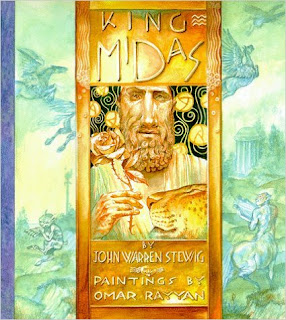

In fifth grade in Texas our special genre for our year is myths. Where fourth grade gets to introduce folktales and tall tales, fifth graders get to dip their toes into Greek/Roman and Norse mythologies for the first time in a school setting.

King Midas is a classic tale of king who loved gold too much, and this retelling of the story is a powerful one with a big dose of whimsy and humor. Fifth graders like details and the illustrations in this book tell the story so well that you can make inferences and draw conclusions just by inspecting all corners of the page with as much attention as if you were chasing down Waldo. 

The story provides many opportunities to talk about character traits and change. It also has heaps of foreshadowing if you look for the hidden pictures inside the pictures. 

The Selfish Giant: Oscar Wilde/Chris Beatrice


This story is a classic, and as much as I love "The Happy Prince", Wilde has a better narrative voice here and the 19th century world is easier for younger modern readers to understand than its other famous companion story. 

The story is amazing, and the illustrations by Beatrice are the most beautiful version I've ever seen in any store anywhere for this classic story. You can really dive into them and hunt out the meaning of the pictures to use practicing predictions and making connections. Beyond that, the symbolism at the end (spoiler: the giant dies) is very challenging and leave some students feeling a little confused though still intrigued. This is good. Some students will be ready to start understanding symbolism already, and others you can start down the path toward carving out those synaptic pathways in their brains. 

Also, it makes a good complement to King Midas because they share similar (though not equal) themes, and reading them both makes for an interesting compare/contrast discussion. 

The Summer My Father was Ten: Brisson


Last but not least, this book is a great example of realistic fiction. I like it because the kids make so many personal connections. Everyone's gotten carried away while playing and done something bad at some point in their childhood, and the lesson about forgiveness and friendship in this book is powerful and deep. 

The illustrations are also deep, just like my other favorite books, adding another layer to the story rather than just being pictures.

Students sometimes like to make the connection between the kids playing in Mr. Bellavista's garden to the children playing in the Selfish Giant's garden. Again, it's another book that really connects well for discussions when read in tandem with the others, even though they all represent different genres.


Finding the Books

While I happened to get two out of three of these books at a Half-Price books in Dallas, they're all available on Amazon in case you can't find them in your school or local library. They're worth owning. You won't regret. 

Sunday, August 23, 2015

Context Clues


D: What are context clues?


  • Context clues are bits of information in a text that help you understand an unfamiliar word.

P: How do I use context clues?


[Glue in handout here]


C: When/why do I use context clues?

  • I use context clues during reading.
  • I use context clues to help me quickly make sense of a new word.

[Make the following T-Chart.]


[Using a mentor text with words you've chosen beforehand, have students use context clues to puzzle out some unfamiliar words. Model a few times and use gradual release model.]


[5.2.B use context (e.g., in-sentence restatement) to determine or clarify the meaning of unfamiliar or multiple meaning words;]

Saturday, August 22, 2015

Summarizing


D: What is summarizing?


  • Summarizing is retelling the most important parts of a story accurately.

P: How do I summarize fiction?

  • I put the right character with the right action in the right order.
  • I focus on the important events.
    • Important events are the events that are connected to the conflict closely.
  • Beginning, Middle, End
  • I use the Fiction 4Q.

[Cut and glue in 4Q foldable.]


C: When/Why do I summarize?

  • I summarize during and after reading.
  • I summarize because it helps me know if I understand and helps me remember the story.


[5.9 Reading/Comprehension of Text/Independent Reading. Students read independently for sustained periods of time and produce evidence of their reading. Students are expected to read independently for a sustained period of time and summarize or paraphrase what the reading was about, maintaining meaning and logical order (e.g., generate a reading log or journal; participate in book talks).  

5.8.A  sequence and summarize the plot's main events and explain their influence on future events;

Fig19.E (E) summarize and paraphrase texts in ways that maintain meaning and logical order within a text and across texts; and]

Imagery


Imagery is descriptive phrases that authors use to help me visualize better.

[Draw a T-Chart labeled "Examples" and "Nonexamples".]


Reread a mentor text together, and using guided release, sort out examples of phrases and sentences that are imagery and that are not imagery and discuss why they are or are not. Some imagery is stronger than others, so talk about it. There's enough gray area to spark some interesting thought and discussion. 


[Fig19.C monitor and adjust comprehension (e.g., using background knowledge, creating sensory images, rereading a portion aloud, generating questions); 

(8)  Reading/Comprehension of Literary Text/Sensory Language. Students understand, make inferences and draw conclusions about how an author's sensory language creates imagery in literary text and provide evidence from text to support their understanding. Students are expected to evaluate the impact of sensory details, imagery, and figurative language in literary text.]

Visualizing

'

D: What is visualizing?

  • Visualizing is making a movie in your mind while you read.

P: How do I visualize?

  1. I understand the vocabulary.
  2. I use my memories to imagine what I'm reading by phrase or by sentence.
  3. I update my visualization as I go.
  4. I pay attention to imagery.
[Glue handout here.]

Imagery is descriptive phrases that authors use to help me visualize better.


C: When/why do I visualize?

  • I visualize while I read.
  • I visualize because it helps me understand and it makes reading fun.


[Figure 19.C (C) monitor and adjust comprehension (e.g., using background knowledge, creating sensory images, rereading a portion aloud, generating questions);]

Fix Up Strategies

What do I do when I don't understand what I read?

  • Reread what I didn't understand.
  • Reading what came before.
  • Slow down.
  • Use context clues or dictionaries to solve new words.
  • Remind myself of what I already know.
  • Talk it out with a partner.
  • (Change books.)
  • Take a break.
  • Talk to the teacher.


{Figure 19.C monitor and adjust comprehension (e.g., using background knowledge, creating sensory images, rereading a portion aloud, generating questions);]

Checking Understanding


D: What is checking understanding?


[Glue in handout here]

  • Checking understanding means I know when I'm reading with my eyes and brain, not just with my eyes.

P: How do I check my understanding?

  • While reading I notice:
    • frustration
    • tired
    • slow
    • many unknown words
    • not visualizing
  • After reading:
    • cannot retell what I read

C: When/Why do I check my understanding?

  • I check my understanding during and after reading.
  • Checking understanding helps me make meaning.

[Figure 19.C (C) monitor and adjust comprehension (e.g., using background knowledge, creating sensory images, rereading a portion aloud, generating questions)]

Previewing Texts


D: What is previewing?

      • Previewing is gathering information before reading a text.

P: How do I preview?

      • For a Book:
        1. I read the whole title and think about it. I predict the genre.
        2. I examine (look carefully) the illustrations.
        3. I read the blurbs.
        4. I set a purpose for reading.
        5. I use the five finger rule.
      • Previewing on a Test
        1. I circle the title and think about it. I predict the genre using clues.
        2. I read the questions and circle 2 or 3 important words.
          • DO NOT READ THE ANSWER CHOICES!

C: Why/when do I preview?

      • I preview before reading. I preview because it helps me choose just-right books and make connections to my schema. This helps me understand what I'm reading better when I begin.

[Figure 19.A (A) establish purposes for reading selected texts based upon own or others’ desired outcome to enhance comprehension;]

Friday, August 21, 2015

Choosing A Just-Right Book


Steps to Choosing a Just-Right Book


  1. Read spines of books and look for an interesting title.
  2. Read the blurb on the back or inside of the book. If it's still interesting, continue, if not, replace on shelf.
  3. Read the first full page of the book and keep count of the words you don't know.
  4. Use the Five Finger Rule to decide if it's a good match for your reading level.
  5. Sit down with the book in front of the shelf or at a table and read the first chapter.
  6. If you like it, check it out!